What Is Noun Clause In Grammar / Print Page How Noun Clauses Behave In A Sentence : Nominals can do whatever nouns can.. It contains a subject and a verb but it does not express a complete thought and cannot stand alone as a complete sentence. A noun clause functions as noun in a sentence. It might be a noun clause. The noun clause is a clause that functions like a noun in the sentence. The noun clause, the adjective clause, and the adverb clause.
You must choose which flavor of ice cream you want. It can be the subject or the object of the verb. It might be a noun clause. What is noun clause a noun clause is a dependent clause that functions as a noun. A noun clause usually contains the conjunction 'that', or an intenogative pronoun or an intenogative adverb.
Clauses Identifying Adjective Adverb And Noun Clauses In from slidetodoc.com It might be a noun clause. Also known as a nominal clause. Noun clauses perform the same functions of a noun. The noun clause is a clause that functions like a noun in the sentence. Adjective, adverb, and noun clauses contain a subject and a verb. You must choose which flavor of ice cream you want. Nominal is a grammatical category for words or groups of words that function as nouns in a sentence. The noun clause is acting as the object of the sentence.
It can be the subject of a sentence, an object, or a complement.
Noun clauses are usually introduced by the subordinating conjunctions that, why, how, if and whether. A noun is a word that names something, such as a person, place, thing, or idea. A noun clause is a type of dependent clause that is able to function grammatically like a noun in a sentence. You must choose which flavor of ice cream you want. The noun clause, the adjective clause, and the adverb clause. Take a look at some sample sentences containing noun clauses to understand their purpose and function. A noun clause functions as noun in a sentence. Updated january 21, 2020 in english grammar, a noun clause is a dependent clause that functions as a noun (that is, as a subject, object, or complement) within a sentence. An adjective clause is also known as a relative clause. A noun clause serves the same purpose as a noun. (like all clauses, a noun clause has a subject and a verb. Nouns can function as subjects, direct objects, indirect objects, object of the preposition, and predicate nominativ. Having trouble finding the subject or object in a sentence?
Updated january 21, 2020 in english grammar, a noun clause is a dependent clause that functions as a noun (that is, as a subject, object, or complement) within a sentence. We know that a noun names a person, place, thing, or idea. A noun clause is a clause that plays the role of a noun. A noun is a part of speech. The italicized words, what you said yesterday, serve as a dependent noun clause.
5 Noun Grammar Rules Of Great Importance Noun Checker from www.nounchecker.com A noun clause is a dependent (or subordinate clause) that works as a noun. Any clause— main (or independent), subordinate (or dependent), adjective (or relative)—that functions as a noun is a noun clause. They function as adjectives, adverbs, and nouns using pronouns or subordinating conjunctions. (like all clauses, a noun clause has a subject and a verb. It can be the subject or the object of the verb. Remember that a noun names a person, place, thing, or idea. The key to writing success = chegg® writing. An adjective clause is also known as a relative clause.
Noun clauses describe something about the verb or the sentence.
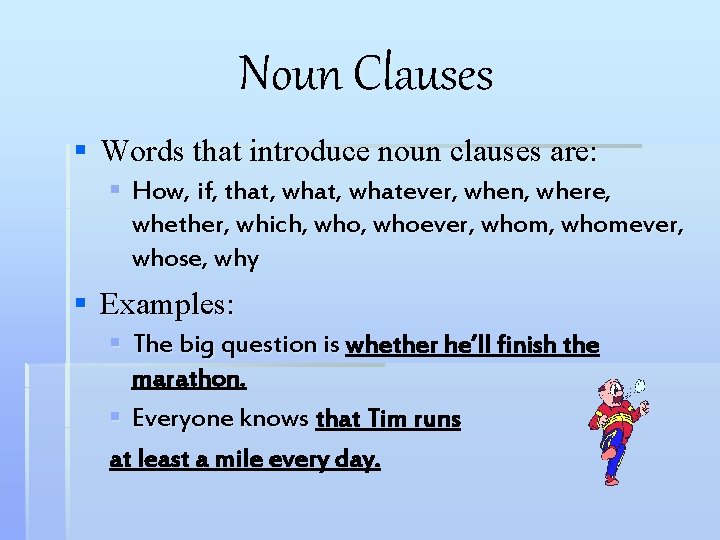
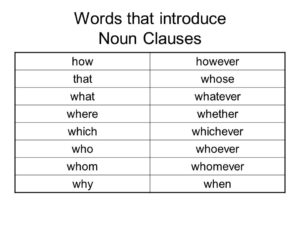
Because of the variety of noun clauses, today i'm only going to try to discuss noun clauses as they are used as objects. (like all clauses, a noun clause has a subject and a verb. It can be the subject or the object of the verb. Take a look at some sample sentences containing noun clauses to understand their purpose and function. I believe that he is innocent. A noun clause is a dependent clause that acts as a noun.noun clauses begin with words such as how, that, what, whatever, when, where, whether, which, whichever, who, whoever, whom, whomever, and why.noun clauses can act as subjects, direct objects, indirect objects, predicate nominatives, or objects of a preposition. I remember what you said yesterday. It can also act as the object of a preposition. A noun clause is a dependent clause that acts as a noun. Remember that a noun names a person, place, thing, or idea. The key to writing success = chegg® writing. It can be the subject of a sentence, an object, or a complement. What the boy told is the dependent clause.
Subordinate clauses are of three kinds: The noun clause is a clause that functions like a noun in the sentence. In this lesson, we'll look at the dependent clause and its conjunction. It can be used as the subject, direct object, indirect object, object of a preposition, subject complement, or appositive. Nominals can do whatever nouns can.
English Noun Clauses Grammatical Functions Youtube from i.ytimg.com We'll explore them acting as subjects, direct objects, objects of the preposition, and predicate nouns. Noun clauses are usually introduced by the subordinating conjunctions that, why, how, if and whether. A noun clause is a dependent (or subordinate clause) that works as a noun. We know that a noun names a person, place, thing, or idea. The noun clause is acting as the object of the sentence. Nouns can function as subjects, direct objects, indirect objects, object of the preposition, and predicate nominatives. It contains a subject and a verb but it does not express a complete thought and cannot stand alone as a complete sentence. Nouns can function as subjects, direct objects, indirect objects, object of the preposition, and predicate nominativ.
It might be a noun clause.
Because of the variety of noun clauses, today i'm only going to try to discuss noun clauses as they are used as objects. A noun clause is a group of words acting together as a noun. It does the work of an adjective. As a noun clause does the work of a noun, it can be subject to a sentence, object of a transitive verb, object of a preposition, apposition to a noun, or complement to a linking verb. As such, it serves to name a person, place, or thing. Correct english grammatical mistakes and enhance your writing. In this lesson, we'll look at the dependent clause and its conjunction. A noun clause can act as the subject or object of the verb in the main clause. Subjects and objects are parts of a sentence. They can perform any of the noun jobs. We have also seen that a noun clause is a subordinate clause which does the work of a noun in a complex sentence. They can be a subject, an object, or a predicate nominative. A noun clause usually contains the conjunction 'that', or an intenogative pronoun or an intenogative adverb.
They can be a subject, an object, or a predicate nominative what is noun clause. We use who, what, which, whose, whoever, whatever, when, where, why, whether, how and that in noun clauses.